
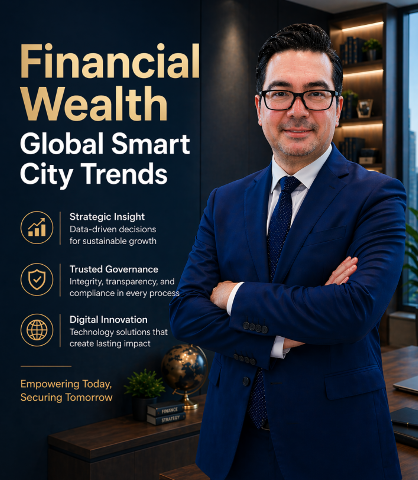
COO’s Insights
Richard Andrew, COO of Financial Wealth Indonesia
As urban transformation accelerates worldwide, Smart Cities are evolving beyond technology-led initiatives into fully integrated ecosystems of governance, sustainability, mobility, and financial infrastructure.
Global trends show that the most successful Smart Cities are no longer defined solely by digital tools, but by how effectively they integrate people, policy, capital, and technology into one connected urban framework.
Today, leading cities across the world are investing in AI-powered governance systems, intelligent transportation networks, smart utilities, green infrastructure, and data-driven public services.
Several major trends are shaping the next generation of smart urban development:
- AI-Driven Urban Intelligence
Cities are increasingly using artificial intelligence and predictive analytics to optimize traffic flows, energy usage, public safety, and emergency response systems.
This shift allows urban leaders to make real-time decisions based on dynamic city-wide data, improving both operational efficiency and citizen experience.
- Sustainable Infrastructure & Green Mobility
Sustainability has become central to global smart city development.
From EV charging ecosystems and smart street lighting to carbon-monitoring systems and intelligent waste management, cities are aligning technology with environmental goals.
- Citizen-Centric Digital Governance
The most advanced smart cities focus on citizen engagement through digital public service platforms, integrated apps, and transparent governance systems.
This creates stronger public trust and improves service accessibility at scale.
Examples of Successful Smart Cities
Singapore — The Global Benchmark
Singapore is widely recognized as one of the world’s leading Smart Cities. Its Smart Nation initiative integrates digital identity systems, real-time traffic management, smart healthcare, and seamless e-government services. Singapore’s success lies in its ability to combine policy leadership with technology infrastructure and long-term investment planning.
Barcelona — Urban Innovation Through IoT
Barcelona is a global case study in IoT-enabled city management. The city uses sensor-based street lighting, intelligent waste collection, smart parking systems, and sustainable mobility networks.Barcelona is often cited as a model for how digital systems can improve operational efficiency and quality of life.
Seoul — Hyperconnected Public Services
Seoul has built one of the most advanced digital governance ecosystems in Asia. Its integrated transport systems, digital citizen services, and real-time urban monitoring platforms make it a strong example of smart governance at scale.
Abu Dhabi — Emerging Global Leader
Abu Dhabi has rapidly advanced as one of the world’s smartest cities, driven by digital public services, safety innovation, and strong public-private partnerships.
Financial Wealth Perspective
For Financial Wealth, these global trends offer strategic insight for Indonesia’s Smart Province vision. The future is no longer about isolated city modernization. It is about building connected provincial ecosystems inspired by global best practices, where capital infrastructure, governance intelligence, and sustainable growth converge.